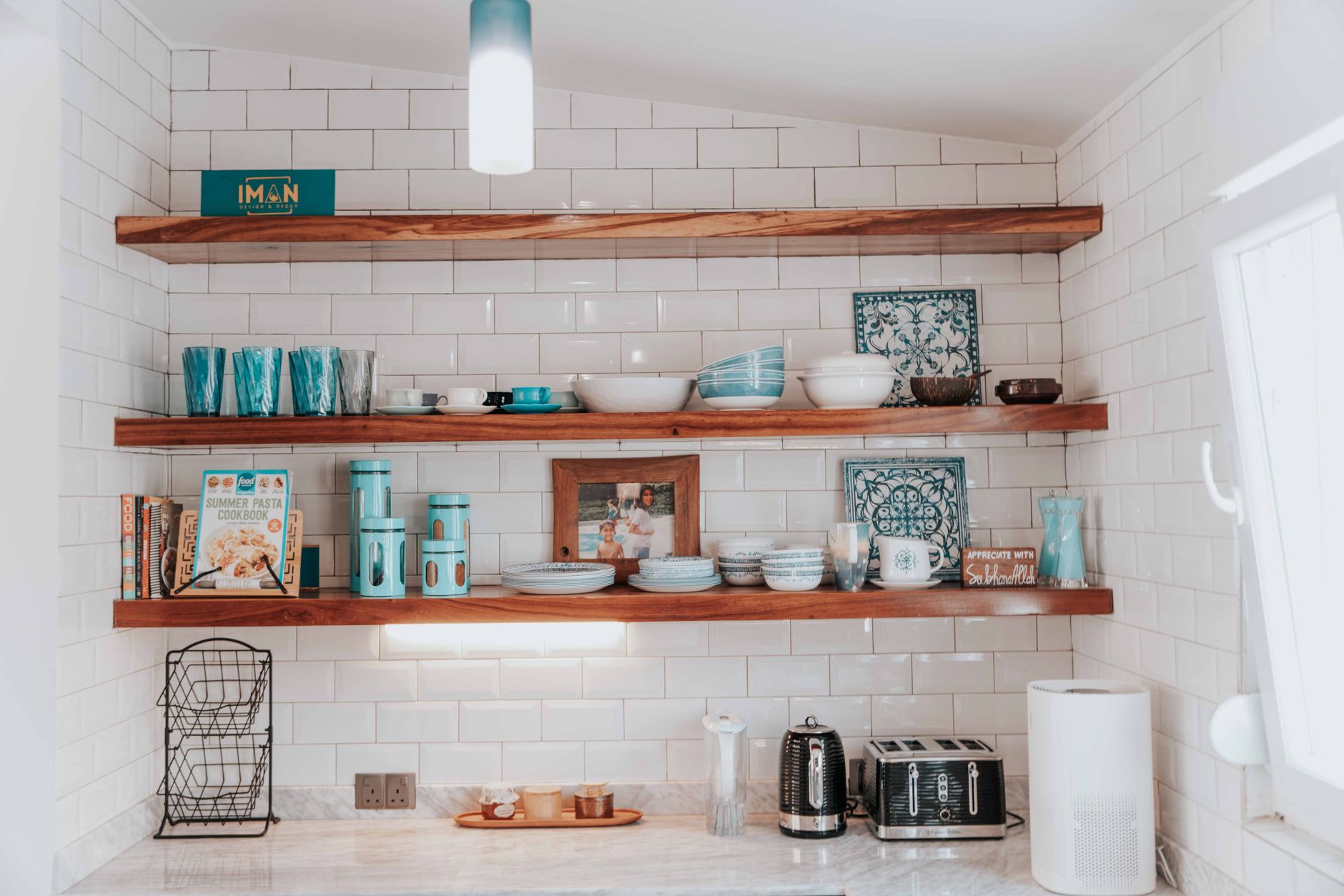
The One Open-Shelf Detail That Makes a Kitchen Feel Finished There’s a particular moment in a kitchen when open shelving either settles into the room or begins to feel like it’s still waiting for something. It’s rarely the shelves themselves that cause the problem. More often, it’s one small detail: the amount of breathing room around what’s on them. That detail sounds almost too simple to matter. But in real homes, it changes everything. A shelf packed edge to edge can make even a beautiful kitchen feel hurried. The same shelf, with just a little restraint, can read as calm, intentional, and lived-in. The room does not need more objects. It needs a little space between them.
Why restraint feels more finished than abundance
Open shelving works best when it looks as if it belongs to the rhythm of the room, not as if it is performing for it. That’s why restraint is such a powerful design choice. It keeps the eye from bouncing from cup to bowl to jar without rest.
A finished kitchen usually has a clear visual hierarchy. There is the work zone, the storage zone, and then the small display zone where everyday items can sit in view without turning the shelf into a stage set. The overlooked detail is often scale: not just what you place on the shelf, but how much of the shelf you leave visible.
That negative space gives objects shape. A stack of plates feels quieter when it is not jammed against a canister. A row of glasses looks more deliberate when it does not have to compete with every available inch.
The shelf begins to feel designed rather than merely filled.
The detail most people miss: leave a margin
If there is one small choice that changes the whole room, it is this: leave a margin at the ends of the shelf, and between groupings. A few inches of air can do more than another decorative object ever will. This margin matters because open shelving is seen all at once.
Closed cabinets hide the visual clutter of density. Open shelves do the opposite. They reveal every packed corner, every slightly chaotic stack, every item that is there because there was nowhere else to put it.
When the shelf has a margin, it gives the room a place to pause. Think of it as the difference between a note and a paragraph. Both can be useful, but one gives you room to breathe.
In many homes, the instinct is to fill the full length of an open shelf so it feels worth having. Yet the more convincing versions usually stop short. They hold only what they need to hold.
That can mean two bowls instead of four. A small stack of everyday plates instead of a complete set. One framed print or a low vase, not a crowd of decorative items.
A kitchen should still look usable
The best open shelving does not pretend the kitchen is a still life. It keeps the things you reach for often within easy view. That’s part of its charm.
The room feels practical because it is practical. But usefulness is not the same as exposure. A shelf can hold daily items and still look composed if you group them by function.
For example, tea items together. Serving bowls together. Everyday dishes together.
This kind of grouping makes a shelf feel like a working system instead of a decorative accident. That is one reason open shelving pairs well with other furniture that has a clear role and a calm visual presence. A kitchen table or nearby dining setup often benefits from the same thinking: choose pieces that give the room room to move.
The same principle shows up elsewhere in the home too, whether you are considering best dining tables for small rooms, seating, and everyday meals or looking for best dining chairs for seat comfort, table clearance, and daily meals. The room feels better when the objects respect one another’s space.
How open shelving changes the feel of the whole room
A kitchen is often judged by its hardest-working details: countertop material, cabinet layout, lighting. But shelving changes the emotional temperature of the room. It is one of the first places your eye rests, and one of the last.
If it is calm, the whole kitchen reads calmer. Too much on display can make a room feel busy even when everything is clean. By contrast, a restrained shelf can make the same kitchen seem larger, lighter, and more cared for.
That is because open shelving does not only store things. It sets the tone for how the room handles visual noise. This is especially true in smaller kitchens, where every object has a louder presence.
A shelf that holds fewer items can make a narrow wall feel more generous. It can also keep the room from feeling top-heavy. When the upper half of a kitchen is crowded, the entire space starts to feel compressed.
A bit of openness restores balance. If you have a tight corner, a short run of wall, or an awkward gap that seems difficult to use well, making the most of narrow spaces with decorative shelving offers a useful way to think about it. The lesson is not to maximize every inch.
It is to use the right inches in the right way.
What restraint looks like in real homes
Restraint does not mean bare shelves or a styled-by-rulebook kitchen. In real homes, it usually looks like this: - a few everyday dishes stacked neatly, not displayed in full inventory - one or two ceramic pieces that add softness without taking over - a small cluster of glassware instead of a long, crowded line - space left between the most-used items and the decorative ones That balance is what makes shelves feel finished. Not because they are perfectly symmetrical, but because they have edited themselves down to what the room can comfortably hold.
You can see the same approach in other furniture decisions too. A room rarely benefits from the largest or fullest option; it benefits from the one that leaves space for movement, cleaning, and ease. That is true of best coffee tables for small living rooms, storage, and daily use as much as it is of shelving.
The principle is the same: comfort often comes from what is not there.
The finish is in the edit What makes open shelving feel complete is not a fuller shelf.
It is an edited one. The overlooked detail is the interval, the gap, the pause. Once that is in place, the kitchen starts to look like a room with a point of view instead of a room still collecting itself.
This is a useful reminder for furniture choices throughout the home. Often, the difference between busy and beautiful is not a new object at all. It is the decision to leave something out, to let a surface rest, to allow one piece to speak without competing with the next.
In that sense, open shelving is less about display and more about discipline. And when that discipline is gentle, the whole kitchen feels more settled. If you’re thinking about how that same sense of calm can work in tighter corners and overlooked wall space, the next read is a natural place to continue.
For a more practical next step, add storage and style to tight corners and hallways without bulk and 5 tv stands and centers for comfortable everyday homes can help connect this journal idea to everyday home choices.