Use case map
If I were narrowing down the best cutting boards for comfortable everyday homes, I would start with the actual prep job and the place it needs to live, not the product label. A board for quick fruit prep, weekday vegetable slicing, or meat prep asks for a different size, cleanup routine, and storage plan than a board meant to stay out on the counter.
The compact single-board option works best when you want one surface that slides easily into a smaller kitchen and does not add much visual bulk. The three-piece sets make more sense when you want a board for each kind of prep, while still keeping the decision simple. A larger slab is the better fit when the main need is room to chop, carve, or serve without constantly shifting ingredients around.
Decision factors
Footprint and clearance matter first. I would look at board size, nearby obstructions, and the route the board has to travel into storage, because a cutting board that seems fine on paper can still be awkward next to a sink, wall, or appliance. The same is true for thicker boards, storage stands, and anything that needs to live upright between uses.
Task fit comes next. Some kitchens need a board that handles everyday slicing and then goes straight into hand washing. Others need a set that separates bread, vegetables, and meat prep more cleanly. Maintenance is part of the choice too, since hand-wash care, juice grooves, built-in handles, and reversible sides all affect how easy the board is to clean up and put away on a busy day. At the higher end of the price spread, you usually get more pieces, more finish detail, or a more complete setup; at the lower end, you often give up extras and pay more attention to the basic board shape and upkeep.
Material and construction signals are worth reading closely. Bamboo boards tend to lean toward a firmer, lighter, or more compact feel than many shoppers expect, but the real question is how that construction matches your routine and your tolerance for wear marks, water care, and storage constraints.
Best for each situation
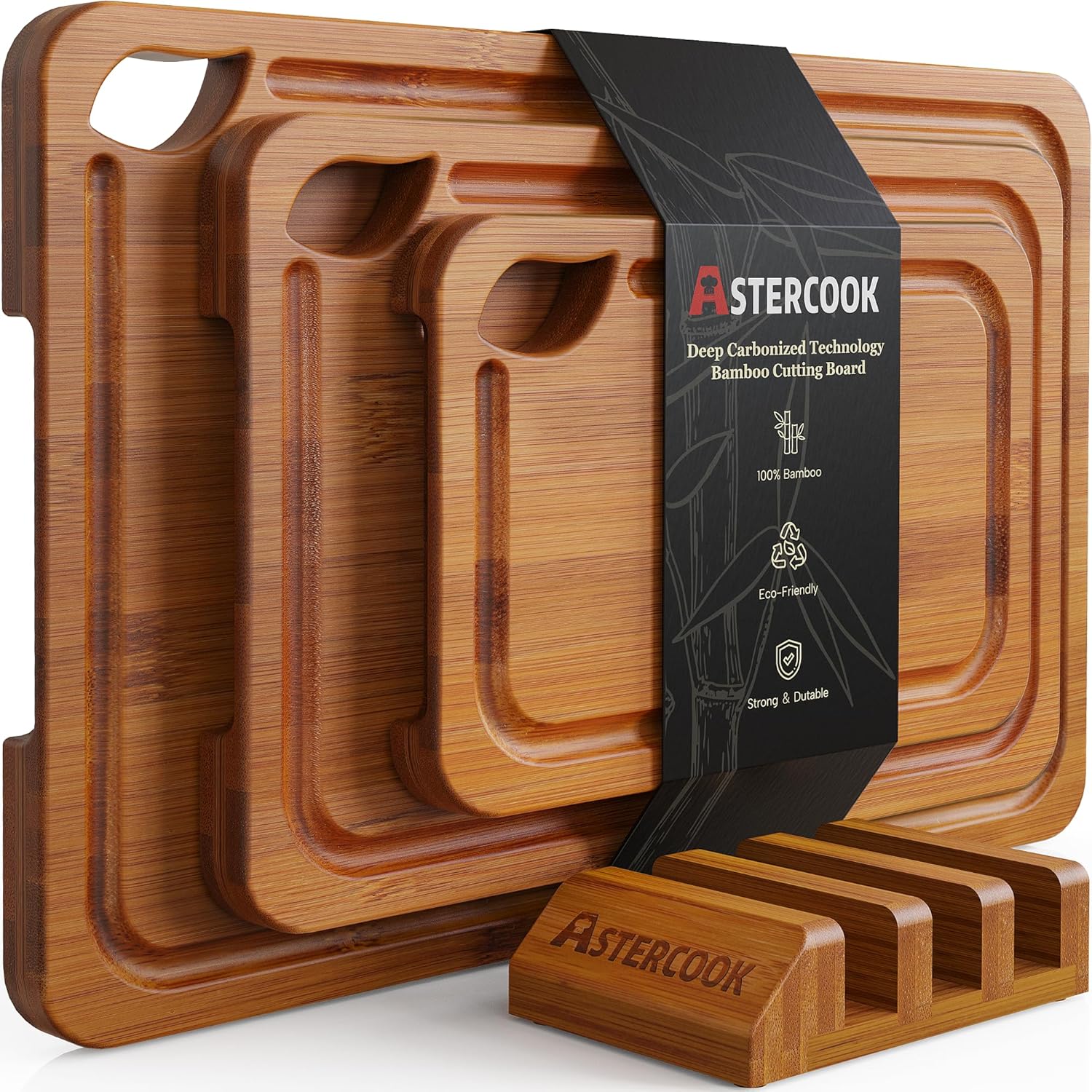
Best overall for a small-space kitchen: the Astercook set with a storage stand. I would put this at the top when counter space is tight and you want the board to have a defined home instead of floating around the kitchen. The reversible layout and stand make the setup easier to keep organized, and the size keeps the footprint controlled.
Best budget pick: the Kitsure board. This is the one I would look at first when the main goal is a basic board that does the core job at the lowest entry point in this group. It is the most straightforward choice when you do not need a full set and are mainly comparing cost against daily slicing needs.
Best for a fuller prep setup: the ROYAL CRAFT WOOD three-board set. I would lean this way when you want separate sizes for fruit, vegetables, and larger prep without buying piece by piece. The tradeoff is that the set asks for more storage space and a higher spend, but it gives you the clearest size separation.
Best for a larger single surface: the Hiware extra-large board. This is the easiest fit when the task is more about comfortable elbow room for meat, fruit, vegetables, or fish prep than about minimizing the number of items in the kitchen. The main compromise is that a bigger board can be less convenient to store if your prep zone is already crowded.
Best for a multi-size middle ground: the Keechee three-board set. I would look here when you want size variety and a lower-profile feel than a bulkier set, but still want more flexibility than a single board can offer. It sits between the one-board budget route and the more complete three-board setup.
Tradeoffs
The biggest tradeoff with cutting boards is not just size; it is the mix of convenience, cleanup, and storage space you accept to get the size you want. A small, simple board is easier to store and clean, but it can feel cramped for bigger prep. A multi-board set solves more kitchen tasks, but it also adds storage clutter and more items to wash and dry.
Another tradeoff is maintenance visibility. Hand-wash-only care is common here, so the real difference is how much effort you want to spend drying, storing, and keeping the surface looking clean. Juice grooves, handles, and reversible sides can help in the right kitchen, but they also change the board’s daily handling and how easily it tucks away.
When price rises, I look for the point where the extra cost buys a better match to the way the kitchen is actually used. If you only need one board for light prep, the budget option may be enough. If you need multiple sizes, a stand, or a more organized setup, it can make sense to spend more so the board choice matches the routine instead of creating extra friction.
Quick answer
For cutting boards, the best shortlist starts with the job it needs to do, the room it needs to fit, and the compromise you are willing to accept. This guide is for readers who are choosing cutting boards with a clearer sense of fit, use case, maintenance, and tradeoffs. Astercook board set with stand is the first pick to compare for small kitchens that need three board sizes stored upright instead of stacked in a drawer. Its current price signal is Under $25. Its review context is 4.5 rating from 1,530+ reviews.
How to choose between these picks
Start by matching the cutting boards to the room, routine, and tradeoff that matters most:
- footprint and clearance around the prep area.
- task fit.
- room fit.
- maintenance.
- visible tradeoffs.
- material and construction signals.
- price spread.
- Daily usefulness.
Measure/check before buying
- Decide the exact job the cutting boards need to handle before comparing finishes.
- Measure the spot, check any nearby clearance, and map the storage path so the board works in the real layout, not just in the listing image.
- Check the care step that is most likely to become annoying once the board is part of the weekly routine.
- Decide which drawback is acceptable to you before you get pulled in by the finish or color.
- Confirm current price and stock status before you call anything the best value, because both can move quickly.
- Use photos to read the shape and setup, then compare the dimensions against your own space measurements.
- Treat rating context as a tie-breaker after the board already matches your space and intended prep job.
Common cautions
- Measure the exact placement area before choosing cutting boards.
- Do not shortlist cutting boards from the main photo alone; match the product type to the job first.
- Call out the main drawback first, then decide whether the board still earns a shortlist spot.
- the board solves a different prep job than the one the buyer actually needs.
- day-to-day cleanup or reach can end up mattering more than the first thing you notice in the listing.
- the stated footprint can miss the space taken by doors, cords, lids, handles, or nearby clearance.
- scale and clearance are easy to underestimate.
FAQ
What matters most when choosing cutting boards?
I would start with the exact job, then check footprint, storage, and upkeep. After that, compare how many sizes you actually need and what compromise you can live with day to day.
What should I check before buying cutting boards?
Measure the prep spot and the storage path, then confirm whether you need one board or a set. I would also check whether the care routine is simple enough for repeated use, because the easiest board to ignore is often the one that gets used most.
Related guides
- Kitchen Tools for Everyday Cooking - Connects this cutting boards decision to the broader kitchen tools for everyday cooking hub.
- Kitchen tools - More kitchen tools guides with related buying decisions.
- How to Choose Coffee and Tea That Actually Fit | Coffee and Tea for Small Spaces: Fit Details to Check - Related internal guide.
- Dinnerware That Balances Style and Practicality for Everyday Meals - Related internal guide.