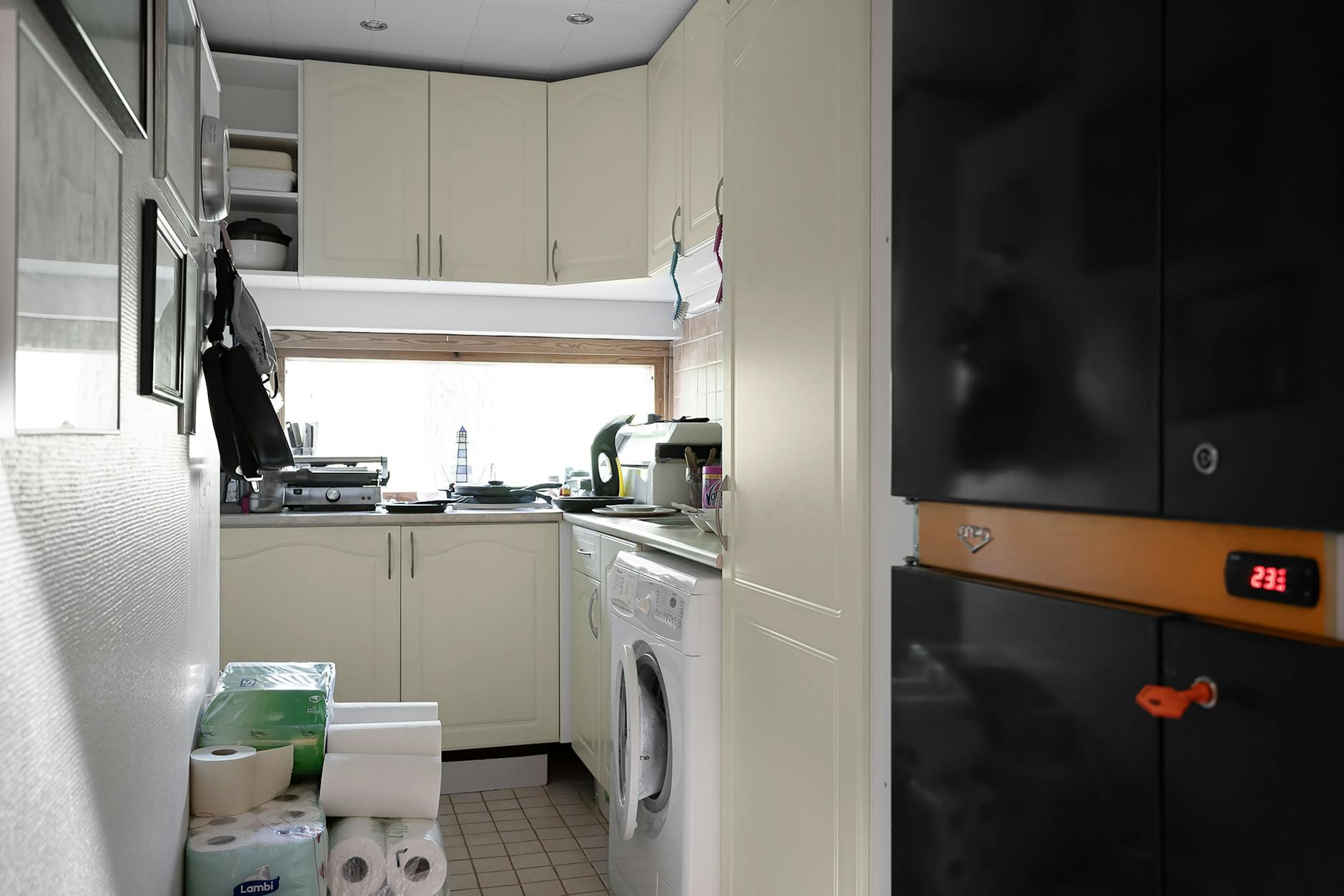
Narrow Cabinet Storage Ideas for a Softer, Smarter Kitchen In storage and organisation, the hard choice is not always the practical one. In a narrow kitchen cabinet, the sharper-looking solution can actually make daily life feel more crowded: rigid bins that leave awkward gaps, bulky organisers that force awkward reaches, labels that look tidy but hide what you actually use. A softer visual choice can be the smarter one when it lets the cabinet work with the shape of the space instead of against it. That is the real promise of narrow cabinet storage. It is less about making a small cabinet look engineered and more about making it feel easy. In many homes, especially older flats and compact kitchens, the narrowest cupboard is the one used most often: spices, oils, mugs, snack jars, cleaning cloths, foil, tea, or the miscellany that never quite belongs anywhere else. When that cabinet is calm, the whole kitchen feels easier to live in.
Why soft lines work in tight places
There is a quiet kind of comfort in storage that does not announce itself. In narrow cabinets, softer visual choices often mean fewer hard edges, fewer oversized dividers, and fewer items forced into a system that only works on paper. A low-profile basket with rounded corners can feel gentler than a tall box with a harsh rim.
Slim trays in a matte finish can disappear visually in a way shiny plastic never quite does. Even leaving a little breathing room between objects can be better than filling every inch. The cabinet looks less crowded, but it also becomes more usable because items can be lifted out without a tug-of-war.
This is especially true in homes where cabinets are not perfectly square. Many narrow cupboards have slight quirks: a shelf that sits too high, a hinge that steals space, a back corner that disappears into shadow. A softer setup adapts more easily to those realities.
It does not demand perfection from the room.
The narrow cabinet is usually doing more than one job In a small kitchen, a narrow cabinet rarely has a single purpose.
It might hold mugs in the morning, cooking oil by lunch, and tea tins by evening. Or it may be the place where extra containers, snack supplies, and flatware all end up because there is nowhere more convenient. That is why the most useful narrow cabinet storage often starts with a simple question: what do I reach for here, and how often?
The answer helps decide whether the cabinet should be used for everyday items, overflow storage, or a mix of both. For many people, a narrow cabinet works best when the most frequent items sit at eye level and the rest are grouped by task. This is similar to the thinking behind smart storage solutions for narrow kitchen spaces, where the goal is not to squeeze in more, but to make the cabinet easier to read at a glance.
If the cabinet is deep and slender, consider setting it up so that each layer has a clear purpose. Tall items at the back. Daily items in front.
Lighter, less-used items up high. The simpler the logic, the softer the space tends to feel.
What to avoid when the cabinet is narrow
A narrow cabinet becomes uncomfortable when it is over-managed. Too many containers can create a visual wall. Too many labels can make the contents feel like a filing system rather than a home.
And deep storage bins, while tempting, often swallow the very things you wanted to make easier to find. It can help to resist matching everything for the sake of neatness. A few coordinated pieces may be enough.
Often, the most practical arrangement is not the most uniform one, but the one that allows your hands to move quickly and naturally. This is where a calmer storage setup can outperform a more rigid one. In a cabinet that needs to hold tea, snacks, jars, or dry goods, it may be better to use a shallow tray that can slide out easily than a deep bin that turns the back row into hidden territory.
A small, soft-sided organizer can sometimes do more for usability than a boxy system built to look tidy from across the room. For pantries and food zones, the same principle shows up in another form. If the cabinet is holding dry goods or backup groceries, how to keep your kitchen organized with the right food storage solutions is a helpful way to think about choosing containers that fit the space rather than dominating it.
A softer cabinet can still be disciplined
Soft does not have to mean loose. In fact, the most restful narrow storage usually has a clear rhythm. One shelf might hold only breakfast items.
Another might be reserved for refill supplies. A lower shelf might carry heavier things in shallow trays so they can be pulled forward without rearranging the entire cabinet. This sort of structure keeps the cabinet from becoming a catch-all while still feeling gentle and lived in.
If the cabinet stores small kitchen tools, a slim holder or shallow basket can keep the contents contained without making them feel trapped. This is one reason I often think about tidying up flatware with smart storage ideas for a warm home as part of the same conversation. Flatware, utensils, tea spoons, and little tools are exactly the sort of items that can make a narrow cabinet feel cluttered fast if they are not grouped with care.
The trick is to let each container do a small, specific job. One tray for packets. One for refills.
One for odds and ends. When the containers are modest in size and visually quiet, the cabinet tends to feel less like a puzzle and more like a well-used corner.
When the soft choice is also the easier one
A softer visual choice often wins because it reduces friction. For example, a woven or fabric-lined bin may look more relaxed than a rigid plastic box, but it can also be lighter to lift in a narrow cabinet where every inch matters. A shallow open tray may appear less formal, yet it can make it easier to see and grab the item in the back.
Even a slightly unfinished arrangement can be more practical if it means you are not forced to decant everything into identical containers. This matters most in real homes, where people are reaching into the same cupboard while making coffee, packing lunches, or clearing up after dinner. A system that looks beautiful only when untouched is not the kind that lasts.
A system that is easy to restore, even on a busy day, is the one that quietly earns its place. For cabinets that border on pantry duty, it can help to borrow from pantry thinking as well. How to organize a narrow pantry while keeping space is a useful next step if your narrow cabinet has started to act like a miniature pantry and needs that same clear, calm logic.
The small test that keeps the system honest
If you are trying to decide whether your narrow cabinet is working, do not start by looking at the front. Open it and ask three questions: can I see what is here, can I reach it without moving three other things, and can I put it back quickly? If the answer is yes, the cabinet is doing its job.
That is why narrow cabinet storage is often less about visual perfection and more about easy return. The best systems let you live normally without causing the cabinet to unravel. They look soft because they are not overbuilt.
They look smart because they are easy to use. And if your narrow cabinet is serving drinks, mugs, or bottles, you may find that one small adjustment changes everything. A clear, compact setup can keep the cabinet calm without asking you to store less than you need.
For a related idea, see how to keep drinks ready without cluttering your space. In the end, the narrow cabinet does not need to become invisible or decorative. It just needs to support the way you actually live.
When the softer visual choice is also the practical one, that is usually a sign the space has finally started to make sense. If you want to keep building from that feeling, the next read looks at narrow pantry storage with the same calm, space-aware approach.