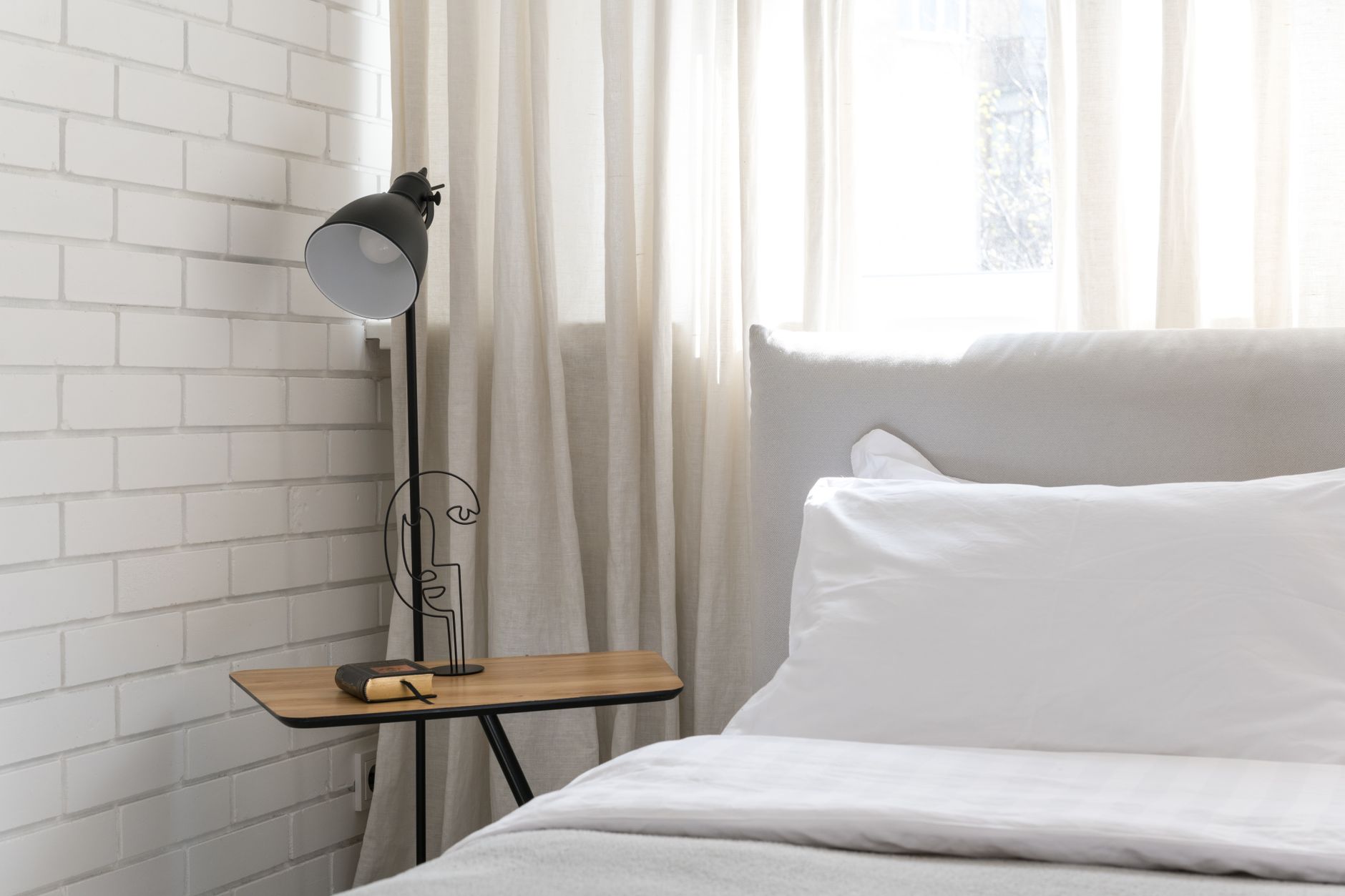
A bedside table is one of the smallest surfaces in a home, which is exactly why it so quickly becomes a place where habits show up. At night, it collects the day’s loose ends: a glass of water, a charger that never seems to stay put, hand cream, a book you mean to return to, receipts, headphones, lip balm, a lamp that feels too bright, then too dim, and somehow a second book for the mood you might have tomorrow. In the morning, it catches the leftovers of intention. It is not just furniture. It is a working corner of the room, and like most working corners, it gets cluttered when we try to solve too many problems at once. The bedside routine, then, is not really about adding the right objects. It often starts with removing the ones that do not belong there.
Start with the surface, not the style
When people think about a bedside setup, they often jump straight to “what should I put on it?” A lamp. A tray. A stack of books.
A candle. A vase. A charging dock.
But a bedside works best when it reflects the actual rhythm of the person using it, not an idealized version of a calm night. The first question is usually simpler: what keeps landing there because there is nowhere else for it to go? If your bedside has become a temporary parking spot for mail, water bottles, hair ties, loose change, and half-used lotion, the problem is not that you need a prettier tray.
The problem is that the bedside is doing the work of the whole room. Clear the surface first, and the real pattern often becomes obvious. A lot of home organization advice begins with adding containers.
In real homes, that can be too optimistic. Before adding anything, remove the items that create daily friction. A bedside should support rest, not become a final sorting station for the rest of the house.
What usually does not belong there
There are a few usual suspects. First, overflow. If a drawer is full, the nightstand becomes the overflow drawer.
If the closet is crowded, the bedside collects the socks, reading glasses, and skincare packets that have not found a proper home. If the desk is too busy, the bedside absorbs work things. That is how a sleeping space starts to feel mentally unfinished.
Second, duplicates. One water glass is useful; three is a habit. One book is comforting; a pile can start to feel like a list of obligations.
One charger is practical; three cables tangle into a small problem that somehow looks larger at 11 p.m. than it does at noon. Third, items that ask for attention instead of giving ease. A bedside is not the place for things that need regular decision-making.
If you keep seeing the same pile and feeling vaguely guilty, it may not be a storage issue at all. It may be a boundary issue. This is where the bedside routine becomes less about tidying and more about protecting your own wind-down.
If it does not help you settle, it is taking up emotional space, even when it takes up very little physical space.
Keep only what serves the night you actually live
A useful bedside routine usually includes only three kinds of things: comfort, function, and one small cue for tomorrow. Comfort might be a lamp, a book, or hand cream. Function might be a phone charger, tissues, or a glass of water.
The cue for tomorrow might be a note, a watch, or the clothes you plan to wear if the morning is likely to be rushed. That is enough for many homes. It helps to think in terms of daily use, not aspiration.
If you never read in bed, the stack of unread books is not part of your routine. If your phone stays on the other side of the room, a charging station by the bed may be unnecessary. If you already have a dresser nearby, the bedside does not need to carry every small item in the bedroom.
In homes where storage has to work hard, pieces like best dressers for comfortable everyday homes with fit, upkeep, and tradeoffs can do more of the heavy lifting, leaving the nightstand for the few things that truly need to be within arm’s reach. What belongs is less about category and more about role.
One clear rule makes the room feel kinder
A bedside is often where the day ends, so it needs to forgive imperfection. But forgiving is not the same as crowded. A simple rule can help: if something has not earned its place by being used nightly or weekly, it probably does not need to stay.
That rule is not severe. It is kind. It means your room is not asking you to manage extra visual noise every time you try to go to sleep.
This is also why the right bedside setup can look surprisingly plain. A lamp, a small dish for essentials, a book, and a glass of water may be all that is needed. The restraint is what makes the routine feel smoother.
Less to dust. Less to knock over. Less to mentally file away before sleep.
And if your bedside is shared, simplicity becomes even more valuable. Two people can easily bring two sets of habits to one small surface. In that case, removing extras matters more than matching decor.
The goal is not symmetry. It is ease.
A bedside table is not a display shelf
It can be tempting to treat the bedside as the most personal surface in the room, which it is. But personal does not have to mean crowded. Homes feel more lived-in when the objects near the bed are chosen with care and used regularly, not when the surface is decorated until it stops functioning.
A bedside that holds only what is needed often feels warmer than one that tries to prove a point. That is true in other rooms too. The same instinct to remove before adding can make a dining area easier to live with when there is less clutter around the table, and a seating choice feels better when it fits the way the room is used rather than the way it looks in a catalog.
For a similar way of thinking in another part of the house, the note on small-room dining tables and everyday meals follows the same logic: start with the room, the task, and the tradeoffs. That is really the common thread across furniture in real homes. The best pieces do not ask for a perfect life.
They support the one you already have.
What to remove before you decide what to add
Before you buy a tray, a lamp, or a clever little organizer, stand beside your bed and remove the obvious clutter. Take away what has drifted there from other rooms. Take away the extras that never get used.
Take away anything that turns the bedside into a to-do list. Then look again. What remains is usually enough to tell you what is missing.
Maybe the room needs a brighter lamp. Maybe it needs a drawer. Maybe it needs a better place for the things that keep migrating overnight.
Or maybe it just needs less, which is often the most useful change of all. If you want to keep refining the rest of the room with the same practical eye, the next read on everyday barstool choices with fit and upkeep in mind carries the same idea into a different corner of the home.